
The Four Patterns of Self-Betrayal — Which One Is Running Your Life?
Most high-functioning women have already done a lot of work. They've read the books. They've seen the therapist. They can articulate the dynamic. They can probably teach a workshop on it.
And yet, the same pattern keeps showing up.
A different person. A different relationship. Sometimes a different industry or city or chapter of life. But underneath, the same internal experience: the override of the first signal, the quiet self-abandonment, the relief that comes too late.
If that's familiar, here's what's likely happening.
You're not stuck because you lack insight. You're stuck because the pattern isn't a thought. It's a learned operating system, one your nervous system put together a long time ago, when staying connected to other people felt more critical than staying connected to yourself.
There are four of these operating systems I see consistently. Most women run a primary one and a secondary that flares under stress. The work begins with naming yours.
1. The Vigilant Protector
Always scanning. Always one move ahead. The body never quite drops its guard, even in safe rooms. From the outside this looks like preparedness. From the inside, it feels like never being able to fully exhale.
The Vigilant Protector keeps people safe by anticipating what could go wrong. It is not paranoia. It is a system that learned, early, that someone else's mood was a weather system you needed to predict.
2. The Emotional Stabilizer
The one who keeps everyone level. Reads the room before walking into it. Carries the emotional weight of the household, the friend group, the team. Often praised for being 'strong' or 'the rock.'
The Emotional Stabilizer learned that her job was to take care of other people's nervous systems. Her own emotions became second-tier — useful only in service of regulating someone else's. Over time, this can show up as exhaustion that doesn't fit a normal definition of burnout.
3. The Inner Negotiator
The one who runs every conversation three times before the first word. Weighs every option. Anticipates every response. Tries to think her way to certainty before acting.
The Inner Negotiator looks like discernment. Often it is overthinking dressed up as wisdom. The pattern formed when the cost of being wrong was too high — when one mistimed answer or unwelcome opinion meant a withdrawal of love or safety. So the system learned to deliberate forever rather than risk a wrong move.
4. The Adaptive Peacemaker
The one who is 'easy to work with.' Soft-spoken. Accommodating. Famous for being low-maintenance. Often unaware of how much of herself she has folded down to keep things smooth.
The Adaptive Peacemaker learned that her preferences were inconvenient. Her job was to fit. Over time, she may not even know what she actually wants — she only knows what would be the least friction.
—
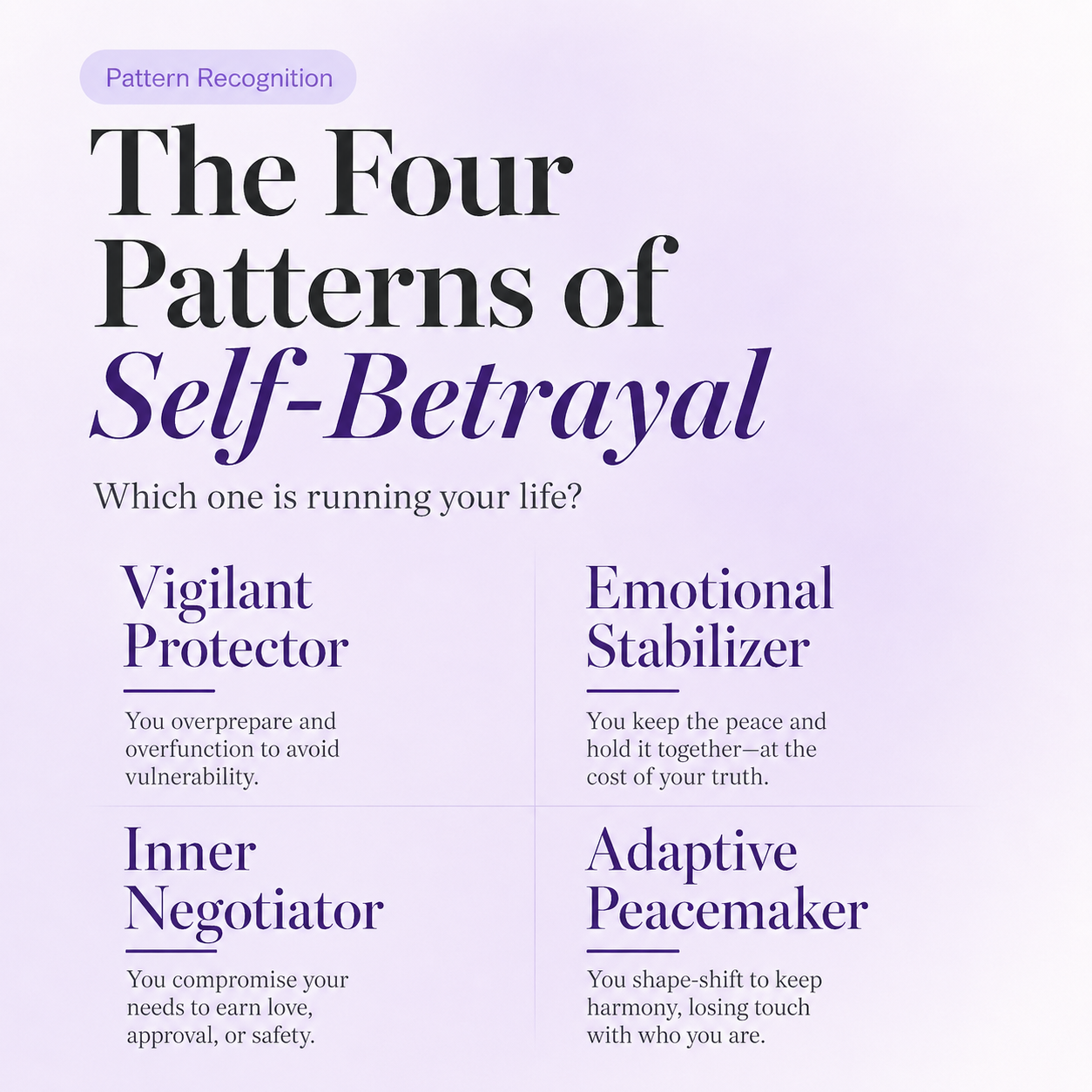
Most women carry traces of all four. But one is usually primary. One is usually doing most of the heavy lifting in your relationships, your career, your inner life.
Naming it is the first move. Not because naming changes the pattern — it doesn't, on its own — but because once you can see the operating system, you stop blaming yourself for the symptoms it produces. You stop trying to use harder effort to fix something that isn't a willpower problem.
The deeper shift comes when your system gets to feel something different. Not when you understand it better. When it gets a new experience.
That's a different conversation, and it's the one we have inside CALM.
If you don't yet know which pattern is yours, the Self-Trust Pattern Assessment will name it for you in about five minutes. It's not a personality test. It's a mirror.
Take the Assessment: https://beinglovedshouldnthurt.com/self-trust-assessment

Being Loved Shouldn't Hurt
The Four Patterns of Self-Betrayal — Which One Is Running Your Life?
Most high-functioning women have already done a lot of work. They've read the books. They've seen the therapist. They can articulate the dynamic. They can probably teach a workshop on it.
And yet, the same pattern keeps showing up.
A different person. A different relationship. Sometimes a different industry or city or chapter of life. But underneath, the same internal experience: the override of the first signal, the quiet self-abandonment, the relief that comes too late.
If that's familiar, here's what's likely happening.
You're not stuck because you lack insight. You're stuck because the pattern isn't a thought. It's a learned operating system, one your nervous system put together a long time ago, when staying connected to other people felt more critical than staying connected to yourself.
There are four of these operating systems I see consistently. Most women run a primary one and a secondary that flares under stress. The work begins with naming yours.
1. The Vigilant Protector
Always scanning. Always one move ahead. The body never quite drops its guard, even in safe rooms. From the outside this looks like preparedness. From the inside, it feels like never being able to fully exhale.
The Vigilant Protector keeps people safe by anticipating what could go wrong. It is not paranoia. It is a system that learned, early, that someone else's mood was a weather system you needed to predict.
2. The Emotional Stabilizer
The one who keeps everyone level. Reads the room before walking into it. Carries the emotional weight of the household, the friend group, the team. Often praised for being 'strong' or 'the rock.'
The Emotional Stabilizer learned that her job was to take care of other people's nervous systems. Her own emotions became second-tier — useful only in service of regulating someone else's. Over time, this can show up as exhaustion that doesn't fit a normal definition of burnout.
3. The Inner Negotiator
The one who runs every conversation three times before the first word. Weighs every option. Anticipates every response. Tries to think her way to certainty before acting.
The Inner Negotiator looks like discernment. Often it is overthinking dressed up as wisdom. The pattern formed when the cost of being wrong was too high — when one mistimed answer or unwelcome opinion meant a withdrawal of love or safety. So the system learned to deliberate forever rather than risk a wrong move.
4. The Adaptive Peacemaker
The one who is 'easy to work with.' Soft-spoken. Accommodating. Famous for being low-maintenance. Often unaware of how much of herself she has folded down to keep things smooth.
The Adaptive Peacemaker learned that her preferences were inconvenient. Her job was to fit. Over time, she may not even know what she actually wants — she only knows what would be the least friction.
—
Most women carry traces of all four. But one is usually primary. One is usually doing most of the heavy lifting in your relationships, your career, your inner life.
Naming it is the first move. Not because naming changes the pattern — it doesn't, on its own — but because once you can see the operating system, you stop blaming yourself for the symptoms it produces. You stop trying to use harder effort to fix something that isn't a willpower problem.
The deeper shift comes when your system gets to feel something different. Not when you understand it better. When it gets a new experience.
That's a different conversation, and it's the one we have inside CALM.
If you don't yet know which pattern is yours, the Self-Trust Pattern Assessment will name it for you in about five minutes. It's not a personality test. It's a mirror.
Take the Assessment: https://beinglovedshouldnthurt.com/self-trust-assessment